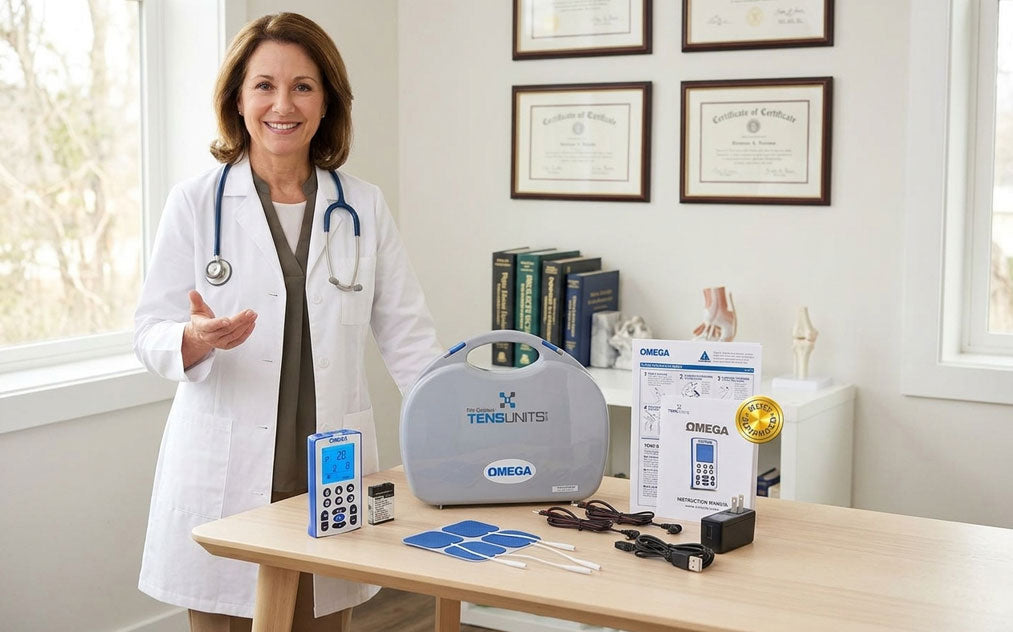

Tens
units have different adjustable settings to control
amplitude (intensity) of stimulation by controlling
the voltage. Current, and pulse width (duration) of
each pulse. Electrodes are placed at specific sites
on a user’s body depending on the physical location
of their pain. The current travels through electrodes
and into the skin stimulating specific nerve pathways
to produce a tingling or massaging sensation that
reduces the perception of pain. When a Tens Unit is
used as directed a T.E.N.S. is a safe, noninvasive,
drug-free method of pain management. A Tens Unit is
used to offer a better quality of life for people
with pain. There are two ways to explain how a T.E.N.S.
successfully decreases or eliminates pain.
One
of these theories is called The Gate Control Theory
and is the most advanced explanation. The gate-control
theory suggests that there’s a neural mechanism
in spinal cord that acts as a kind of gate, shutting
down or opening up the flow of signals from the periphery
to the brain. Whether the gate is open, closed or
partially closed depends on what sort of signal it
receives from the brain to change the perception of
pain in the user’s body. These frequencies interfere
with the transmission of pain messages at the so spinal
cord level, and help block their transmission to the
brain.
Another
theory is called The Endorphin Release, which suggests
that electrical impulses stimulate the production
of endorphins and enkaphalins in the body. These natural
morphine-like substances block pain messages from
reaching the brain, in a similar fashion to conventional
drug therapy, but without the danger of dependence
of other side effects.
T.E.N.S.
are used by hundreds of thousands of people all over
the world for the relief of physical pain. This is
why hundreds of doctors, nurses, and patient technicians
often recommend that their patients use s T.E.N.S.
unit for minor and major pain relief. The most trusted
source for medical information for doctors and health
professionals is the Merck manual. The Merck manual
suggests Tens Therapy for pain Relief. (to
read more about this click here)
Some
common uses for T.E.N.S. treatment are: acute and
chronic pain, post op incisions and post surgical
pain, labor, and delivery, migraine and tension headaches,
acute pain from sports and other injuries, arthritis,
chronic pain from tendentious and bursitis, cancer
pain, and wound healing.
1.
General Information about Tens Therapy
2.
Non-Drug Pain Treatment
3. About Pain
1. General Information about
Tens Therapy
It was Melzack and
Wall’s research in the 1960’s that led
to their coined named in 1965 called the “Gate
Control Theory. When they first published their research
in 1965, it was realized that electricity played an
important part in reducing pain. The first practical
test of the Gate Control Theory was the development
of a transcutaneous electrical nerve stimulation unit
called a TENS (2) Dr. Chris Wells has written extensively
on the subject of pain and a TENS UNIT. He states,
“A TENS ….. “ is low intensity ….it
doesn't’t’t hurt and produces just a tingling
sensation and a high frequency stimulation and is
about 100 times per second” He goes on to say,
that if touch fibers could be stimulated, the resulting
messages passing into the spinal cord would “jam
the pain messages. Input of this type actually seemed
to close the pain gate.” ‘…..a current
is then generated from a battery- powered unit. It
produces tingling sensations on the skin beneath the
pads, which sometimes spread between the pads. For
the best result, the
tingling must mix in with the pain and produce a pleasant
substitute for it. Pain clinics often instruct patients
in the use of these machines ….your doctor’s
technician will be glad to demonstrate how you should
use your unit”
Today’s medicine continues to draw on ancient
and future discoveries. Advanced
research will often draw from the old technology and
combine it with new advances. For example, a TENS,
which uses …”electrical nerve stimulation
is a rediscovery of long- known principles.”
“The
ancient Greeks used a similar method with electric
eels to relieve pain of headaches and gout. Documents
prepared by physicians of the period show that significant
care was taken to select the appropriate type of fish
for the pain” (3).
Hand-held
generated electricity became so popular in the 19th
century that it was used to relieve pain and cure
disease. Queen Victoria was very innovative for her
time. When she became pregnant with her first child,
she stated that she did not want to have pain during
childbirth. She was the pioneer of anesthesia and
used it during her labor. (4) We can thank her for
opening the door of acceptance that enduring any type
of pain is not only physiologically harmful to us,
but emotionally as well.
“Almost a century later the gate control theory
demonstrated that there was a
physiological explanation for the use of electricity,
and if applied correctly for the right type of condition
it might be an appropriate and harmless treatment”
(5).
2.
Non-Drug Pain Treatment
According to “The Merck Manual of Medical Information,”
latest edition, the world’s most widely used
medical reference book, they write as follows about
non-drug pain treatment:
“The more common approach to treating pain is
to use drugs, but there are many other treatments
that can be used to help relieve pain. Often, treating
the underlying cause eliminates or minimizes the pain.
For example: Setting a broken bone in a cast or giving
antibiotics for an infected joint helps reduce pain.”
“Applying cold or hot compresses, often help.”
“Some other treatments include ultrasound, which
provides deep heating and may relieve the pain of
torn or damaged muscles and inflamed ligaments. Some
people find pain relief by using a (TENS), transcutaneous
electrical nerve stimulation unit, which brings a
gentle electric current when applied to the skins
surface, relieves pain.”
“In this technique, large surface electrodes
are taped to the skin to stimulate the underlying
nerves that supply the painful area. Under the patient’s
control, the current is gradually increased until
a tingling is felt. The stimulus is provided by a
small hand-held box, and the patient is in complete
control after an (initial training) period. This technique
is widely used in the United States and Europe for
localized pains, for postoperative pain, and during
labor.”
To understand how Tensunits work
first there must be an understanding of how pain works.
Please read below to get an basic understanding of
how pain effects the human body.
-
-
-
-
-
-
-
-
-
-
QUOTES
“Your chronic pain is all in
your mind.”
(Reality: Chronic pain is in the brain—not
in the mind.)
Dharma Singh, Khalsa, M.D.
If
suffering alone, all the world would be wise. To
suffering must be added love. ANNE MORROW LINDBERGH
WHAT IS PAIN?
According to “Dorland’s Illustrated
Medical Dictionary” 30th edition it states
that PAIN is a more or less localized sensation
of discomfort, distress, or agony, resulting from
the stimulation of specialized nerve endings. I
t serves as a protective mechanism insofar as it
induces the sufferer to remove or withdraw from
the source. BASELINE PAIN is the average intensity
of pain experienced for 12 or more hours in a 24-hour
period.
THE UNIVERSAL EXPERIENCE
Do you suffer from constant or intermittent
pain? Have you been to doctor after doctor, only
to receive prescriptive temporary narcotic pain
relievers? Or made to believe that “you’re
just getting old”, “it’s all in
your head,” or it’s stress”?
-
Pain is a universal experience.
-
Pain is the body’s alarm signal.
-
Pain may be caused by many any number of factors
(reasons?)
-
Pain signals tell us that there is problem requiring
attention.
-
Relaxation techniques are suggested along with
using a TENS as well as a healthy diet and exercise.
-
Pain
is often short-lived with not significant impact.
-
In most cases it can be temporarily helped with
over-the-counter pain relievers.
-
When constant pain persists medical attention
is often sought.
-
Pain is the second most common reason for visiting
a doctor after respiratory infections.
-
The majority of patients say their pain returns
even after therapeutic treatments.
THREE TYPES OF PAIN
(to read more about pain please click
here)
(1) Episodic pain recurs periodically and can disrupt
daily routines.
(2) Pathophysiological pain episodes are difficult
to relieve and often misunderstood.
(3) Acute pain can be unremitting, extending for
long periods of time, often years, or permanently
It
is estimated that more than 50 million Americans
have some form of
persistent or recurrent pain problems.
Pain interferes with our everyday living in hundreds
of different ways. Some of these
ways are:
SOME OF THE EFFECTS OF PAIN
Pain
is an emotion
Pain is for “real”
Pain is the reverse of pleasure
The word “pain” has many connotations.
It is used in such idioms as:
· It pains me to have to tell you.
· I have pain from a broken heart.
· The painful reality of the situation is….
The
fact that you feel pain, no matter what the reason
is, means your pain is “real”, for “real.”
Pain takes a toll on your body and can often lead
to other physical ailments. Overall, it causes continued
physical and emotional stress on your body.
USING TENS TO CONTROL PAIN
You don’t have to feel powerless
anymore. Use the latest in pain control technology.
Our direct discount pricing makes it affordable for
you to purchase our TENS which will relieve pain by
bringing more blood flow to your painful area.
TENSUNITS.com also has other pain relief units called
an Interferential Unit and a
Muscle Stimulator (EMS), that is used for more specific
problems associated with pain. Your doctor or therapist
will recommend which one is best for you. To read
about the differences between different units please
click here
THE CYCLE OF PAIN
Inside our body is a very complex system
of electrical signals that travel through a very complicated
pathway system of nerves. The exact way that this
system works still to this day is not completely understood.
The basis of our knowledge originates from two different
areas of our bodies, the Brain and the Nerve receptors.
These two areas are well understood by the medical
community. The way that these parts of the body communicate
are not completely understood. TENS are designed to
interfere with the communication of these two areas
of the body to help relive the cycle of pain.For
example: When a cell phone is used to dial a number
it immediately transmits (sends) an airwave path to
the dialed number. The reception is either clear,
weak, or non-working on the air pathways.
The cycle of pain can be interrupted by endorphins,
distraction and electrical impulses (TENS)
The
communication of pain to the brain from nerve endings
or "cycle of Pain" works through a complex
system. First, the area of pain travels through our
body to the spinal cord. It then quickly continues
to the spine until it reaches the subconscious part
of our brain. Finally, the message is sent to the
conscious part of our brain. This is where our brain
pick-ups the warning and evaluates the situation and
let us know if something is going wrong by giving
pain.
When
a doctor performs a specific minor operation he/she
will numb the area. If it’s major operation
he/she will use anesthesia. For example: An abdominal
operation would entail making an incision and anesthetizing
us so there will no feeling of pain. Our nerves around
that area are now not capable of sending brain signals.
The pathway to our brain is not able to send a message
from that injured location. Our brain can only receive
pain messages from individual routes in our body.
This automatic process has been learned by observing
newborns. When they feel pain they will withdraw into
a fetal position and cry or scream. He/s knows that
it has been hurt, but is not yet able to distinguish
where the pain is coming from. By the time an infant
is one year old its brain will have developed the
sensory to tell where specific pain is coming from.
This is a built-in protective circuit.
It
was not until the 1960’s that pain research
officially began. That is when more and more studies
began to prove “The Cycle of Pain Theory”.
This
same research discovered that pain can manifest itself
in different ways. There are scenarios where people
will experience severe pain in their left arm and
their immediate reaction is to assume that they were
having a heart attack. The person goes to the closest
hospital to be diagnosed by a doctor. Since the nerve
pathways are located in the same pathway as for heart
the person is confused and assumes that they are having
a heart attack. As mentioned earlier, infants brains
learn different pain paths. But since heart attacks,
gallbladder problems, and certain other adult illnesses
usually occur later in life, our body has not yet
been programmed to be able to send an accurate alert
pathway message to the brain, telling us where the
exact location is.
Researchers now know that once this pathway is open
and our brain continues to receive painful messages,
other factors come into play. Our whole pain transmission
process becomes super sensitive and the pain continues
long after the initial trigger cause. It no longer
needs another stimulus. We might describe this as
saying our brain has been programmed to have continuous
lasting chronic pain.
Research
has also discovered that after the initial body injury
has supposedly been healed, ten years later the patient
can still feel the pain from that same area. This
is why time after time so many people go back to their
doctor for another pain evaluation in the same area.
But when the doctor reexamines the area he finds nothing
wrong. This can lead to a lack of trust and confidence
between doctor and patient.
Another
major pain discovery has been made about pain pathways.
Our brain not only receives pain messages, but it
can also send messages through this same pathway to
our spinal cord and subconscious part of our brain.
The reason for this response is so the brain can order
the release of chemicals that will actually reduce
or prevent pain. This chemical is called endorphins.
They are our body’s natural painkillers, and
they are one of the most or the most built-in reserve
unit powerhouse that we have. We each produce varying
amounts of endorphins, depending on the circumstance
and the degree of pain we have.
When
people experience and accident and are injured there
are endorphins that are "injected" into
the blood stream. These endorphins are natural pain
killers and will temporarily stop the receptors for
pain. Endorphins make us feel good in order to buy
(give) us time to get help or to find help. TENS devices
have been shown to release endorphins through the
electrical stimulation.
People
with long-term chronic pain can become depressed and
may not cope or function well. This may be because
their station gates are wide open, allowing more pain
messages through to their brain.
All
humans have pain tolerance and pain threshold. They
can vary in each of us, depending on different circumstances
and the way someone feels at the time. Experiments
have shown that people can tolerate more pain if people
are watching or are around during an injury. There
are many different factors involved in peoples threshold
to pain. For example: If a person pinches a finger
in a drawer, they may go over their threshold-but
the pain may pass
shortly. On the other hand, if someone breaks a finger
they will surpass their pain tolerance and quickly
go to the emergency room.
There
is fast pain and a slow pain. Using the above example-the
pinched finger-displays fast pain to get the bodies
attention so that the brain will quickly tell someone
to retract their finger from the drawer. This is known
as a post warning,. A normal reaction would be to
rub the injured finger and/or put heat on it to make
it feel better This personal attention will somewhat
or totally close off pain gates so that the brain
receives less pain.
Slow
pain is more complex than fast pain. It references
in past experiences schema (background) resources
to tell people how to react to more serious pain injuries
(situations) such as similar situations. Slow pain
tolerance level varies depending on past experiences
and how the person feels at the time of injury. They
also may react differently to slow pain verses fast
pain. Instead of quickly pulling away (retracting
from the situation) the muscles become contracted
or freeze, allowing time for the body to compose itself
and to
release endorphins to the area. Both types of pain
react positively to comforting,
soothing, and rubbing, etc.
Both
types of pain receive messages to the brain by pain
receptors. These pain receptors are tiny nerve endings
throughout the body that continuously scout (observe)
unusual physical feelings. There are two types of
pain receptors. One lies just beneath our skin. These
tiny nerve endings register fast and slow pain. The
second one also carries pain receptor messages to
the brain but they are located in peoples joints and
all of the large internal organs. For example, touching
hot and cold or sharp and blunt objects to the skin.
Some receptors constantly give back general information
while others report damage or injury. Different pain
receptors send different sensations to the brain so
it can decipher which type of pain to report.
Researchers have discovered that each type of pain
receptor has its own pathway that carries messages
to the brain. Painkillers affect each pain receptor
differently. Depending on the strength, they block
slow pain receptor messages of chronic pain, but can
have little effect on fast-pain receptor messages
to the brain. Painkillers work on pain tolerance,
but have little or no effect on pain threshold.
According to Dr. Chris Wells and Mervyn Jones, “This
technique has been fine-tuned by medical science,
and doctors can achieve the same effect [without using
pain medication], by electrical nerve stimulation,
known as TENS [which stands for transcutaneous electrical
nerve stimulation].
POSSIBLE CHRONIC-PAIN SIDE EFFECTS:
immobilization . bed rest . energy loss . less movement
. weight gain . bed rest . insomnia . tissue deterioration
. muscle tightness . spasms . unemployment . missed
work . lack of job concentration . loss of income
. worry . lack of self-confidence . decrease in social
life . depression . lack of sexual function &
desire . family difficulties . role changes . dependence
. withdrawal
The longer people have chronic pain, the more difficult
it is to get rid of. That is why so many people continue
to seek stronger and different pain medications. Doctor
and pharmacists call this the “analgesic ladder”.
Aspirin, codeine, or morphine related drugs are progressively
used so they may find pain relief. If you have pain
at this moment and are either overusing non-prescriptive
or prescriptive drugs, over time all or some of these
medications most likely will have negative side effects
or will create a tolerance and fight pain less and
less.
Along
with using a TENS unit you may find that exercise
is one of the most powerful pain fighters there is.
By exercising, endorphins are released to help desensitize
pain feelings. (please consult your doctor before
exercising)
FOODS
THAT MAY HELP REHABILITATION AND LESSEN PAIN(please
consult with your doctor concerning your diet)
Reducing
total fat intake and eating more EFA’s (essential
fatty acids) may help a persons health to produce
more endorphins. EFA’s can be found in fish,
flaxseed oil, and in certain cooking oils. Omega 9
oils have also shown to have excellent health benefits.
These can be found in avocados, olive oil, almonds,
sesame oil.
Staying away from saturated fats, meats, cheese, eggs,
pastries, have been shown to help with peoples overall
health. A key to overall health is to take a daily
natural vitamin.
WATER - Our bodies are made up of 70% water.
The formula for knowing the correct amount of water
to drink daily is to take your body weight and divide
it by two and that will give you how many ounces of
water you should drink per day.
MASTERING RELAXATION TECHNIQUES WITH
TENS?
Pain researchers and doctors who work
with chronic pain will tell you that it is almost
impossible to have pain without having tight muscles
or muscle spasm. The more tense a person with chronic
pain becomes the more pain they have been shown to
occur. This is why (TENS) research, (TENS) clinical
trials, and all types of doctors have recommended
using a TENS unit for all degrees of pain. It has
been shown to relax the muscles around an injury and
bring blood flow to the area, allows the body to become
less tense, and muscle spasms can disappear or be
reduced.
To read more about the treatment of pain
Chapter
43 from the Merch Manual.
Section
6. Brain and Nerve Disorders
Chapter
94. Low Back Pain